Reimagining the Cut-Up Technique: Inside the Lyric Chopper
Writer’s block is a universal creative hurdle. Whether you are drafting a poem, writing a song, or composing prose, staring at a blank screen can be paralyzing.
Throughout history, artists have turned to unconventional techniques to break through these barriers. In the 1920s, the Dadaists pioneered the “Cut-Up Method,” which was later popularized in the 1950s and 60s by writer William S. Burroughs. By physically cutting up newspaper articles, diaries, and books with scissors and reassembling the fragments, Burroughs found that he could bypass rational filters to discover startling new combinations of words.
Legendary musicians like David Bowie, Kurt Cobain (Nirvana), and Thom Yorke (Radiohead) adopted this exact technique to write some of their most iconic lyrics. Bowie, in particular, would cut up sentences and rearrange them on his desk to spark fresh, visual lyric sequences.
At Kennebec, we wanted to modernize this tactile creative process. Our latest web application, Lyric Chopper, translates the physical cut-up method into an instant, interactive digital workspace.
The Concept: A Digital Word Sandbox
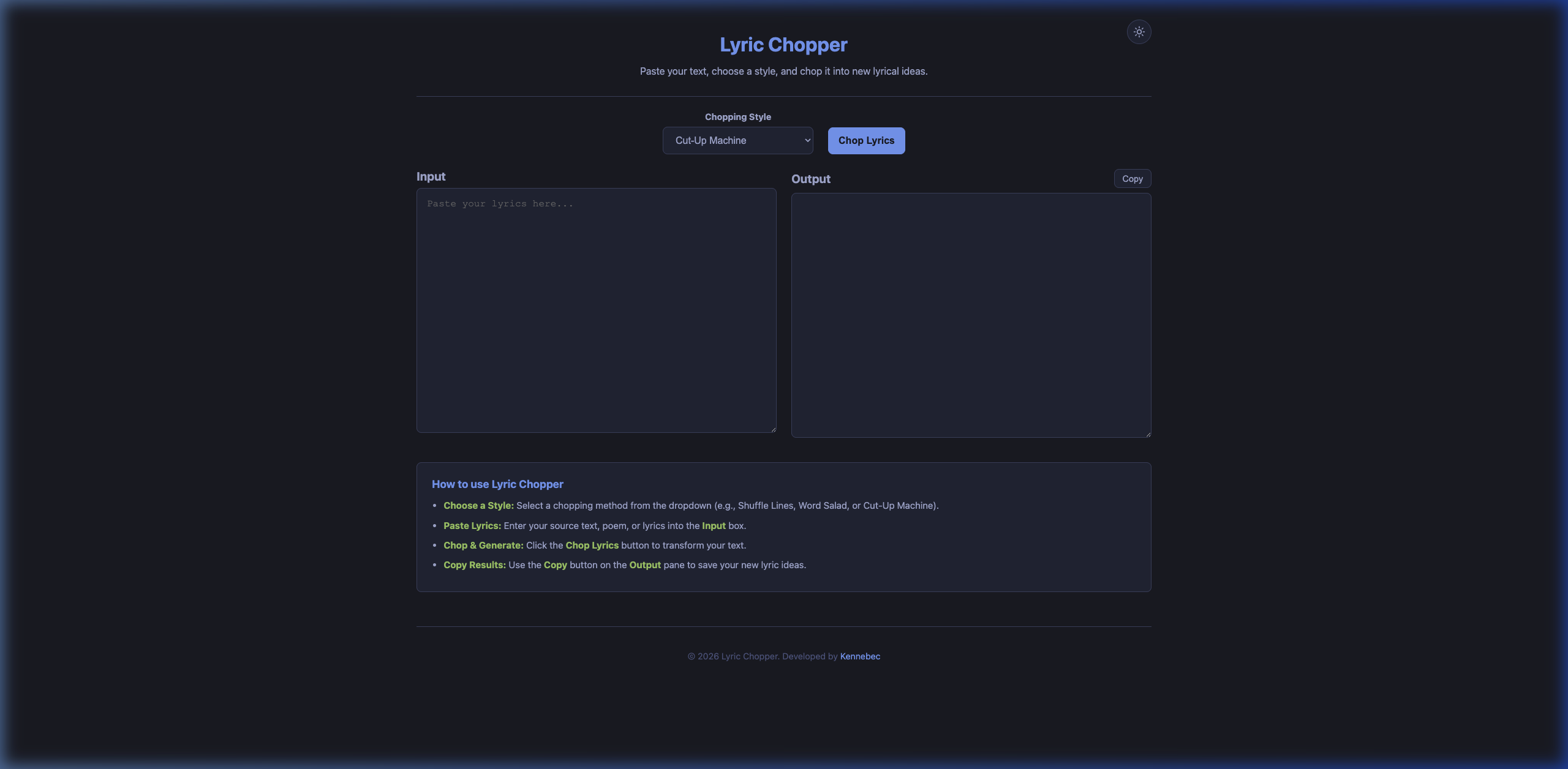
Instead of searching for scissors and paper, Lyric Chopper provides a low-friction interface to paste your thoughts, notes, or existing lyrics, choose a transformation style, and instantly generate new perspectives.
The tool isn’t meant to write the song for you; rather, it acts as a collaborative partner. It rearranges your own raw material to reveal rhythms, rhymes, and juxtapositions you might not have intentionally composed.
The Chopping Arsenal: 7 Ways to Deconstruct Text
To give writers a variety of creative options, we implemented seven distinct text-manipulation engines:
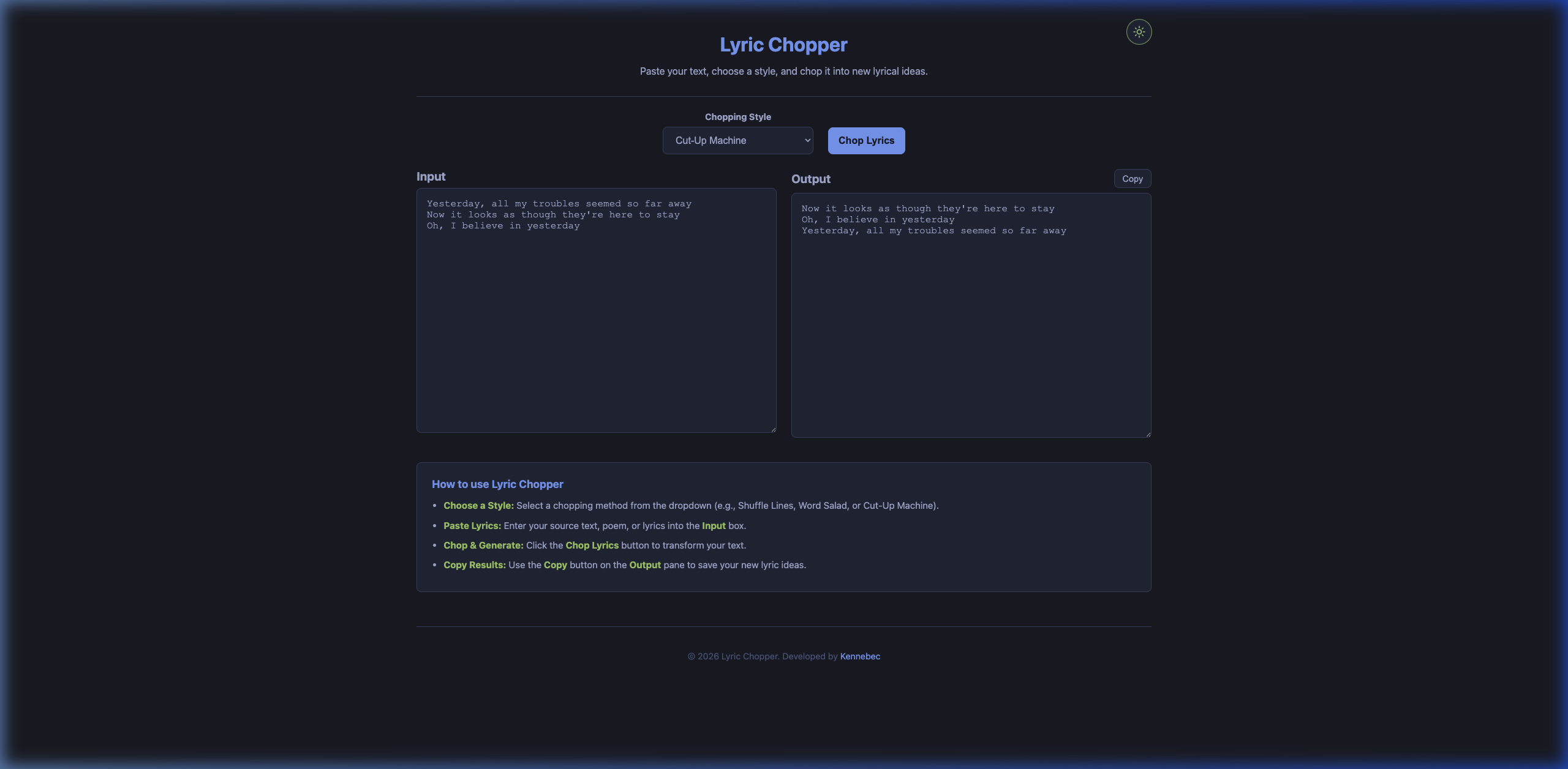
- Cut-Up Machine: The classic Burroughs method. It splits each line or sentence down the middle, shuffles the left halves and right halves separately, and sutures them back together. The results are often surreal and evocative.
- Shuffle Lines: Keeps your individual lines intact but shuffles their vertical order. This is perfect for rearranging the narrative structure of a poem or song.
- Word Salad: Explodes the entire input into individual words and scatters them randomly. This creates abstract word clouds that are excellent for finding unexpected pairs of descriptors.
- Stutter / Repeat: Adds rhythmic, musical repetitions to random words (e.g., repeating the first letter
w-w-wordor doubling up words). This introduces a syncopated, glitched texture to the text. - Ad-Lib Generator: Dynamically injects classic backing vocals and ad-libs—like
(yeah),(uh), and(what)—into the spaces between your words, helping you hear the cadence of a vocal performance. - Verse Maker: Enforces structure by formatting the input into stanzas of exactly 8 words per line, helping you fit freeform thoughts into a strict rhythmic meter.
- Rhyme Finder: An online tool that analyzes your input text and scans for matching rhymes within your own words, grouping them so you can see where your draft naturally holds assonance and harmony.
Under the Hood: Lightweight, Privacy-First Architecture
Building a tool for writers meant prioritizing speed, simplicity, and privacy. Here’s how we architected Lyric Chopper:
1. Zero Backend, Total Privacy
Creative writing is deeply personal. To ensure complete privacy, Lyric Chopper runs entirely client-side. The text you paste never leaves your browser, and no server-side databases or analytics track your drafts. Even the Rhyme Finder performs its queries anonymously via the public Datamuse API, processing results instantly in the client.
2. Prevent FOUC (Flash of Unstyled Content)
To deliver a premium user experience, the application features an instant, micro-animated dark and light theme toggle. We prevented the jarring “flash” of dark/light themes during initial page loads by injecting a tiny, blocking inline JavaScript IIFE at the very top of the <head> to detect system preferences and initialize the theme before the HTML renders.
3. Vanilla CSS Custom Properties
Instead of loading bulky CSS frameworks, we styled the interface using CSS variables linked to the HTML root data-theme attribute. This keeps the codebase incredibly small and ensures that colors, borders, and shadows transition smoothly when toggling themes.
Get Creative
Whether you want to generate abstract poetry, write experimental hip-hop verses, or just shuffle a journal entry to see what patterns emerge, the Lyric Chopper is free and ready to use.
Check out the tool here: Lyric Chopper.
Interested in building lightweight, fast, and beautifully designed web tools? We specialize in developing high-performance client-side applications. Get in touch with the team at Kennebec.