Building Custom DSP Plugins for Karhide’s Next Album: Vektra & Hybrid Synth
As a developer and DSP programmer, I love creating custom tools that solve specific creative challenges. Recently, electronic and post-rock artist Karhide approached me with a unique request: they needed a tailored set of software instruments to write and produce their upcoming album.
Karhide wanted a distinct sonic palette—one that could blend organic, cinematic acoustic textures with heavy, industrial, metallic post-rock synthesis. To support their vision, I built two custom VST3 plugins: Vektra (a hybrid acoustic/synthetic drum machine) and a Hybrid Wavetable-Physical Modeling Synthesizer.
These instruments are serving as the primary sound engines for the new album. And once the record is finished, both plugins will be included as an exclusive bundle when you purchase the release.
Here is the story behind how I developed them, how they work, and how they are shaping the new music.
Vektra: Morphing Rhythm Between Two Worlds
At the heart of any rhythm track is the tension between the organic and the electronic. An acoustic snare has depth, air, and friction; a synthesized snare has precision, drive, and frequency weight. Vektra was built to bridge this gap.
Rather than stacking samples or layering synth tracks in a DAW, Vektra is designed around a dual-engine architecture on a per-pad basis:
- Acoustic WAV Engine: A sample-playback engine I developed to handle organic acoustic drum samples, room mics, and atmospheric noise loops.
- Electronic Synth Engine: An analog modeling engine that generates structural, high-tech synthesized drum sounds with deep parameter control (pitch sweep, decay, noise color).
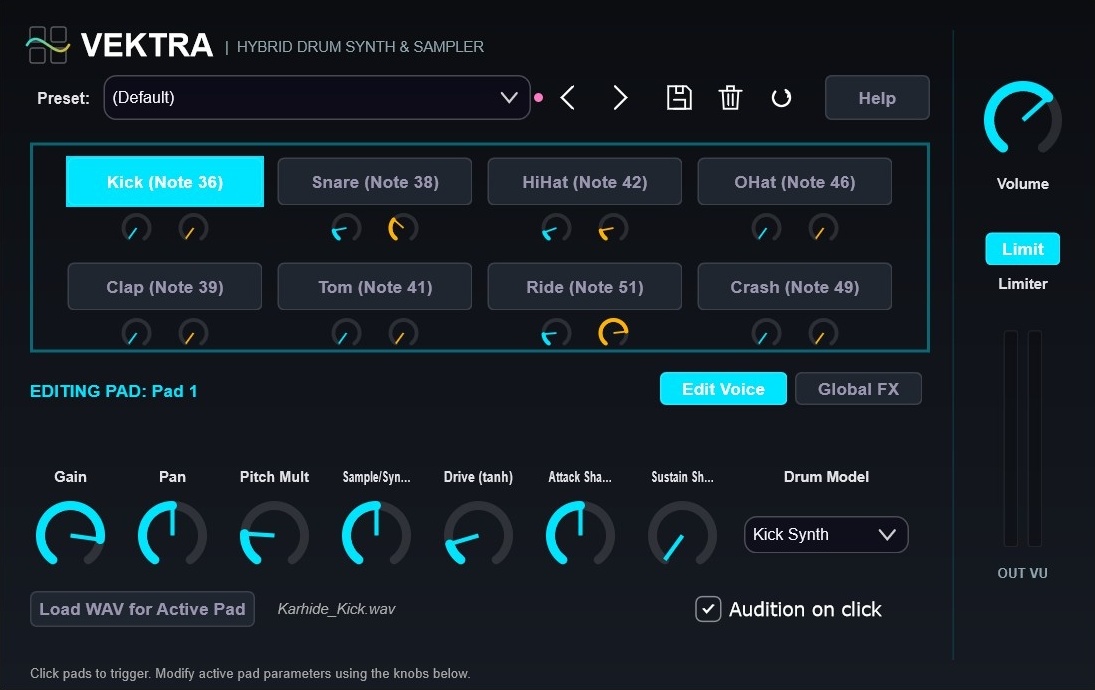
Using a central Mix Dial on each of the 8 drum pads, Karhide can morph seamlessly from an organic, room-recorded acoustic woodblock to a metallic analog rimshot. This dynamic sweeping changes the physical response of the percussion, allowing a drum beat to sound completely organic in quiet passages and gradually freeze into a hard, industrial synth groove as the track builds.
This relationship is also represented in the Vektra logo: a 2x2 grid (representing Karhide’s rigid rhythm pads) interwoven with a flowing cubic bezier curve (representing the DSP algorithms and code I wrote), rendered in an electric-cyan to glowing-amber gradient.
Visualizing the Sound: The Interface and FX
I designed Vektra’s interface to prioritize speed and visual clarity. Using an obsidian glassmorphic theme, I integrated send knobs directly below each pad button:
- D-Send (Cyan): Connects the pad to the global Stereo Delay, complete with tape pitch-bend sweeps when changing values.
- R-Send (Amber): Connects the pad to the global Stereo Reverb.
This allows Karhide to quickly sculpt space without digging through secondary tabs. A dynamic Tooltip HUD at the bottom of the interface tracks every interaction, displaying the parameter name, its current value (formatted in decibels or musical notation), and a brief, educational explanation of what that control does.
The Hybrid Wavetable-Physical Modeling Synthesizer
While Vektra handles the rhythmic foundations, the melodic and atmospheric weight of the album is driven by a new Hybrid Wavetable-Physical Modeling Synthesizer.
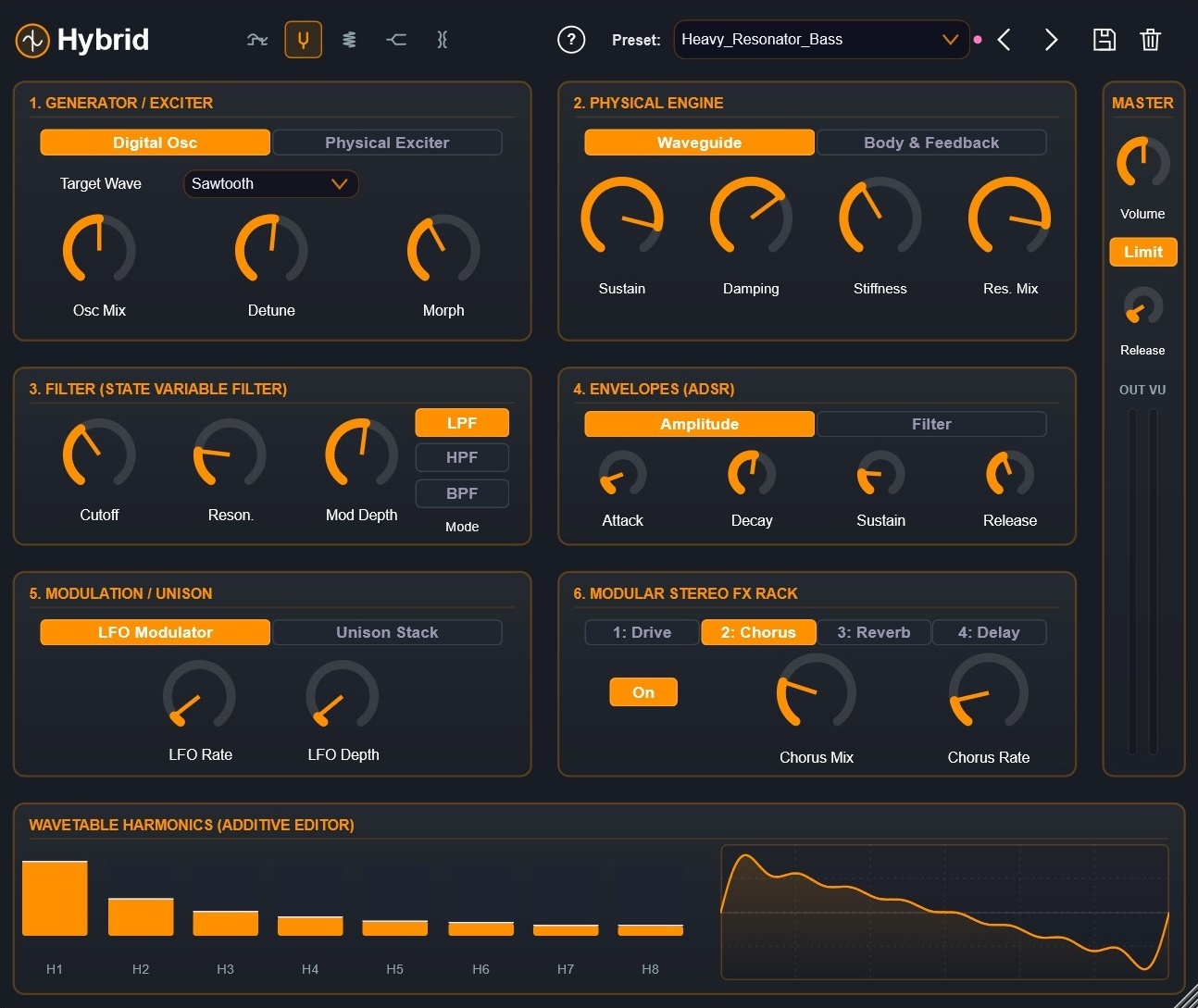
Typically, synthesizers use digital filters (low-pass, band-pass) to carve away frequencies from a waveform. This hybrid synth takes a different route, replacing standard filters with a physical waveguide resonator model that simulates how string vibration and acoustic tubes respond to physical excitation.
1. The Morphable Digital Engine
The sound starts in the digital domain with a dual wavetable oscillator stack:
- Morphing Waveforms: Continuous, sample-accurate interpolation from standard sine waves to custom morph targets (including vocal, metallic, and organ textures).
- Additive Harmonic Editor: An 8-slider additive editor where custom harmonic spectra can be drawn in real time.
- Unison Stacks: Oscillator 2 supports up to 5 unison voices with geometric spreads, generating wide, lush stereo soundscapes.
2. The Physical Waveguide Resonators
Instead of routing this digital source through standard filters, we feed it into a physical waveguide delay line. Here, the waveguide can be struck, plucked, or bowed using six simulated exciters: Pick, Finger, Bowed String, Hollow Tube, Mallet, and Strummed.
The synth also simulates electromagnetic pickups by dynamically tapping the delay buffer, mimicking the comb filtering you get when moving a guitar pickup relative to the bridge.
Routing Modes and Aesthetic Themes
To navigate these engines, I built 5 distinct synthesis routing modes. Selecting a mode dynamically updates the entire interface with a dedicated glassmorphic theme:
- Hybrid Mode (Cyan Theme): Digital wavetable synthesis only, bypassing the physical resonators. Used for deep sub-basses and clean synth leads.
- Resonator Mode (Orange Theme): The wavetable oscillators act as a physical exciter, feeding into the waveguide resonator to create acoustic-like string instruments.
- Scanning Mode (Pink Theme): A mass-spring physics simulation sweeps the wavetable morph index, producing chaotic, metallic overtones.
- Parallel Split Mode (Purple Theme): The waveguide handles sharp transient strikes (like a pluck), while the digital wavetable sustains a warm underlying pad.
- Physical Mode (Emerald Theme): Bypasses digital oscillators, using feedback loops in the physical resonator to generate pure acoustic feedback and pipe resonance.
At the output stage, the signal flows through a modular, drag-and-drop FX rack featuring Tube/Tape drive, Stereo Chorus, Synced Delay, and a Reverb module equipped with a pitch-shifted Shimmer mode for ambient textures.
Packaging the Tools with the Release
Writing an album is usually about documenting a finished product, but for Karhide, this record is as much about the process and the custom instruments as it is about the music. Developing Vektra and the Hybrid Synth has given Karhide complete control over their sonic environment. Instead of forcing them to adapt their ideas to fit general-purpose commercial software, I built the software around their specific creative needs.
Because these plugins are the DNA of the new record, they are packaged directly with it. When Karhide’s album launches, both plugins (VST3/AU formats) will be included when you purchase the release.
Whether you want to dissect the factory presets (which include 28 curated presets from the synth and custom kits from Vektra) or use them to build your own sonic landscapes, the tools will be yours to use.
As a developer, it is incredibly rewarding to see these tools in action, and I can’t wait for other producers and sound designers to get their hands on them.